
The relationship between women’s economic empowerment and green growth is inextricable and tense. A growing concern in the climate transition agenda is its impact on women’s employment and livelihood generation. Any transition towards green growth will reduce the share of women in employment, with employment gains made through such a transition benefiting mostly male-dominated industries such as renewable energy, manufacturing, and construction. This is largely a result of women still being overrepresented in the lowest paid and informal jobs and having limited access to social protection. A climate transition will disproportionately affect women and their livelihoods, and the trade-offs therefore need to be explicitly addressed to prevent women falling into poverty amid rising energy prices, the collapse of sectors they work in, and inaccessible new job opportunities.
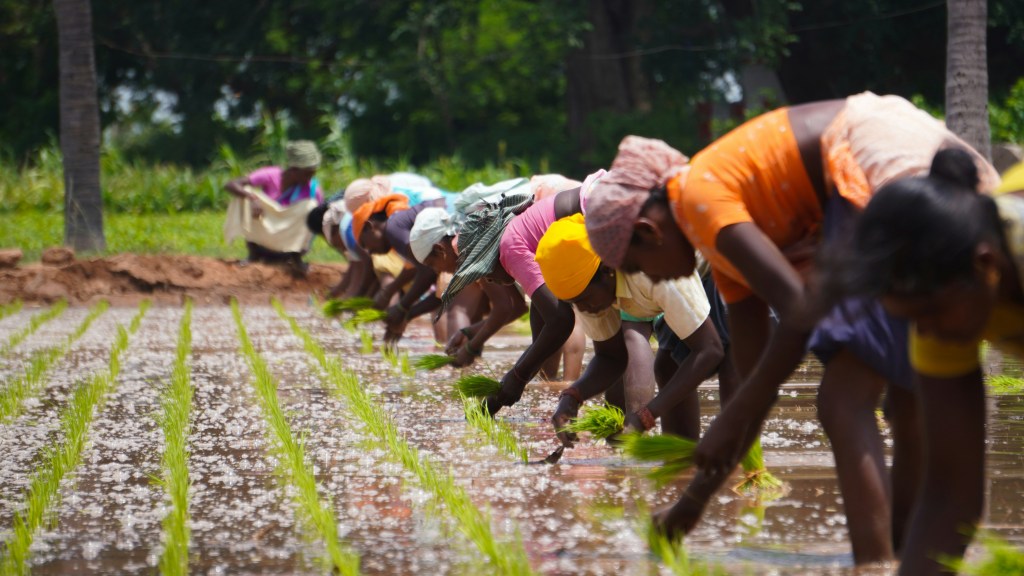
Photo by Deepak Kumar on Unsplash
A gender-inclusive green growth economy will need to simultaneously target gender equality, environmental sustainability, and economic growth. In 2018, the Asian Development Bank (ADB) established a new benchmark to help countries assess their quality of growth and put into motion the ADB Inclusive Green Growth Index, which measures 28 indicators organised around three pillars: sustainability of economic growth, the economic participation in society of a broad range of people including women, and environmental impacts. While the index focuses on the three pillars of green growth independently, their interdependence is not clearly established. The Lima Work Programme on Gender and Gender Action Plan is the main instrument currently in place to achieve gender-responsive climate policy and action and has been the main driver integrating gender equality ambitions into nationally determined contributions and national adaptation plans. However, large gaps in evidence, discriminatory social norms, lack of financial support, weak capacity of government officials and key stakeholders, and a lack of resources persist.
Multiple factors make a just climate transition for women challenging, including limited ownership of assets, constraints to livelihood generation, and strict gender norms. Land is the most important economic resource, particularly in low- and middle-income agriculture-based economies. While women play a critical role in agricultural operations, they have limited access to and control over land. When women do own land, the area of their plots is either smaller or the quality inferior than land owned by men. Globally, the share of women agricultural landholders is less than 15 percent. With lower ownership of physical assets that can be used as collateral, women are less likely to own a bank account or have access to credit. Additional barriers such as lower level of digital access for mobile money payments further limit women’s access to finance.

Photo by Ives on Unsplash
In developing countries 92 percent of women are informally employed, and in a majority of countries worldwide, the percentage of women workers in informal employment exceeds the percentage of men workers. Informal jobs are lower paid and at greater risk during climate shocks as well as in the transition to net zero. Women also earn less than men and are under-represented in occupations and sectors in the green economy. For example, women represent only 32 percent of employees in the renewable energy sector.
Potential new jobs in the green sector will need highly skilled workers, and women currently hold the majority of low-paid and low-skilled jobs; therefore, they are less likely to be hired. Without policy interventions, the energy transition will create more employment opportunities for men than for women.
Additionally, the stringent social norms that limit women’s mobility, time, and voice isolate them into domestic roles, burden them with rising care responsibilities and declining food and water security, even as men increasingly migrate to places with better prospects. Furthermore, during climate shocks, as social controls and protections are disrupted, women and children face greater risk of becoming targets for gender-based violence.
Continued inaction will worsen the impacts of climate change on women, leading to increased poverty, displacement, and loss of life and livelihoods. At the 28th United Nations Climate Change Conference COP28, 68 countries signed a new Gender-Responsive Just Transitions and Climate Action Partnership to mobilise action around three core pillars: better quality data to support decision making in transition planning; more effective finance flows to regions most impacted by climate change; and education, skills, and capacity building to support individual engagement in transitions. While the partnership sets the direction and showcases intent, breaking the cycle of pre-existing inequalities would require urgent collective action from governments, businesses, and civil society.

Photo by Milind Ruparel on Unsplash
The 2030 Agenda for Sustainable Development and the UNFCC Gender Action Plan emphasise the relationship between green growth and women’s economic empowerment, highlighting the need for macroeconomic frameworks supporting green growth to address the constraints to women’s economic empowerment. While the right approach to implementing gender-sensitive green growth strategies will depend on the economy and the gender context, there are varied economic risks and vulnerabilities that will need to be integrated into programming, policy formulation, and influencing.
Building inclusive tax systems and addressing gender biases in tax policies can influence women’s decisions to engage in paid work, including in green sectors, which can reduce the reliance on informal working and break the gendered occupational segregation. Additionally, gender-responsive climate investments can generate revenues and spread risk through diversified portfolios for investors, drive value addition, and amplify gender impact. Globally, only a negligible number of green bonds have gender as their priority objective. Integrating a gender component in bond frameworks in the form of gender analyses, gender action plans, and mandatory reporting requirements would help improve the adoption and implementation of gender integration into climate investments.
Additionally, a debt-restructuring agenda that both addresses gender concerns and supports climate investments, especially among developing countries with unsustainable debt burdens, would be a step towards a just climate transition. This would include a greater focus on progressive taxation that facilitates spending on healthcare and education and helps ensure that women workers receive living wages that allow for universal access to food and nutrition. Promoting gender equality within rapidly growing carbon markets is necessary. As the demand for expensive higher-integrity carbon credits that meet robust environmental and social standards rises, there is an opportunity to integrate gender with clear guidance and examples for how project developers could label projects as ‘gender inclusive’.
Increasing training services to help upskill women workers and reskill them for a transition to green jobs and mobilising employment programmes that can connect women workers to jobs in emerging green sectors are also gaining momentum.
Close attention must be drawn towards evidence that women’s leadership and participation improves climate action. A study of the 159 global companies identified by the Climate Action 100+ initiatives as the largest corporate greenhouse gas (GHG) emitters found that firms with more gender-diverse boards performed much better in eight out of nine climate indicators. They were also seen twice as likely to develop a decarbonisation strategy and 25 percent more likely to have medium- and long-term GHG reduction targets, in addition to greater potential for allocating future capital aligned to these targets. Despite this, between 2009 and 2021, the proportion of women delegates at COP meetings rose only from 30 percent to 38 percent, and the proportion of female Heads of Delegation only increased from 10 percent to 13 percent.

Photo by Dipakar Roy on Unsplash
The Global Green Skills Report 2023, a study undertaken by LinkedIn across 48 countries, reveals that the green talent pool is 66 percent male; nine in ten women lack any green skills; and the green skills gender gap has grown by 25 percent in the past seven years. In the renewable energy industry, women make up 34 percent of workers, while in other industries, this rises to 44 percent—a gap of 10 percentage points. To close the gap, women will need to join the talent pool at 2.5 times the rate of today.
As the gender-climate nexus continues to gain prominence in the areas of policy, programming, and climate finance and investments, any meaningful progress will rely on enhancing women’s leadership and participation in climate action and decision-making, increasing their access to green jobs and skills, providing adaptive social safety nets and livelihood diversification, investing in resilience and disaster risk reduction, and addressing social norms.
 The FEM Network